History of the Casa
Casa Santa Maria dell’Umiltà is the graduate department of the Pontifical North American College, founded in 1859 by Blessed Pius IX to prepare priests for service to the growing Church in the United States. Following the renewal of ecclesiastical studies mandated by the Apostolic Constitution Deus Scientiarum Dominus of Pope Pius XI and the events of the Second World War, the College’s seminary department was transferred to its present campus on the Janiculum hill, while the original site was retained as the College’s residence for ordained priests studying for advanced degrees at the Roman universities.
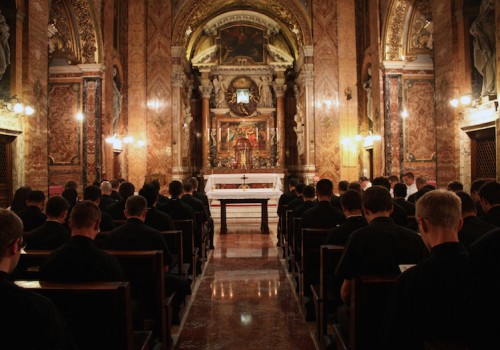
The Casa is housed in a former monastery of Dominican nuns established in 1601 and dedicated to Our Lady of Humility. The conventual church of Our Lady of the Assumption, now the Casa chapel, was consecrated in 1653 and sumptuously decorated with precious marbles and frescoes in the mid-eighteenth century. Following the dissolution of religious orders during the Napoleonic period and the subsequent restoration of the Papal States, the monastic complex briefly became home to a convent of Visitation nuns before being destined by Pius IX to the use of the newly-founded American College.
The original cloister and the adjoining garden and fountains, together with the chapel and the frescoed refectory, are silent reminders of the building’s venerable past, while the modern library, kitchen facilities and well-equipped fitness center serve the needs of its present residents. As a house of study and prayer, Casa Santa Maria combines an atmosphere of sobriety with an active liturgical and community life.
Today, as in the past, the Casa’s priest residents benefit from the broad spectrum of academic programs offered by the various pontifical universities and faculties, ranging from the traditional disciplines of philosophy, theology, spirituality and canon law to more recent fields such as ecumenism, marriage and family studies, psychology and priestly formation. Their studies are further enriched by daily contact with the history and life of the Christian community in Rome, the experience of quiet prayer and contemplation at the tombs of the martyrs and saints, and the closeness of the Successor of Peter and his concern for the needs of the universal Church.
Further reading:
Robert F. McNamara, The American College in Rome, 1855-1955: Rochester, 1956.
Stephen M. DiGiovanni, The Second Founder. Bishop Martin J. O’Connor and the Pontifical North American College: Trafford, 2013.
Aldo Cicinelli, The Church of S. Maria dell’Umiltà and the Chapel of the North American College: Rome, 1970.
Picture caption:
The main altar in the Casa Santa Maria Chapel (1645), with the much-venerated image of Our Lady of Humility, patroness of the Pontifical North American College.